
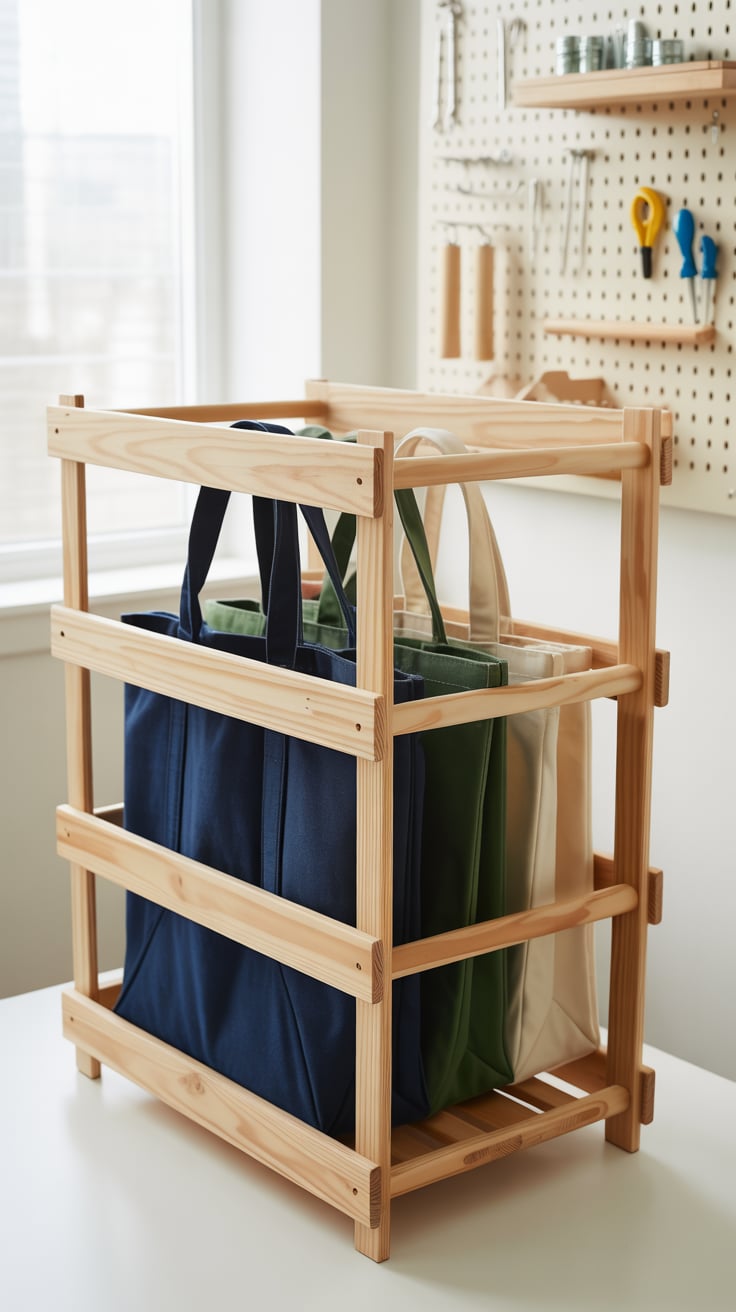
If you’re tired of plastic bins toppling like dominoes or eating up precious floor space, this Easy DIY Project: Tote Storage Rack will transform your garage, shed, or utility room. You’ll build a sturdy, customizable rack that keeps totes accessible, off the floor, and organized by season or category—without needing a cabinetmaker’s skill set. This guide covers planning, materials, cut lists, assembly steps, safe wall-mounting, and smart finishing, with options for small spaces and budget builds.
For an optional jump-start with printable drawings and alternatives, you can pull plans from the massive library at TedsWoodworking.
Table of Contents
Plan a tote rack that fits your space and your bins
Before picking up a saw, dial in the dimensions and type of rack you need. “Measure twice, build once” saves time, lumber, and frustration—and ensures your totes slide in smoothly.
- Measure your totes: note length (L), width (W), and height (H). Common 27-gallon totes are roughly 30″ L x 20″ W x 15″ H, but yours may differ. Always measure the lid, too—many lids flare beyond the bin body.
- Choose shelf clearance: add 1–2″ above tote height so you can angle totes in and out. Example: 15″ tall tote → 16–17″ of vertical shelf space.
- Pick rack type:
- Freestanding: self-supporting; ideal if you can’t fasten to walls. Must be braced well to prevent racking.
- Wall-anchored: occupies less depth and resists tipping; best for garages and basements.
- Decide bay width: a “single-bay” holds one tote per level; a “double-bay” holds two totes side-by-side per level. A single bay is great for tight spots; double bays maximize wall space.
- Set depth: shelf depth should be 1–2″ greater than tote width (the narrower tote dimension) so bins sit securely but don’t get lost behind the frame.
Pro tip: Sketch your rack and mark stud locations on your wall. Most walls have studs 16″ on center, but verify before you cut. If you plan to anchor, it’s easier to line your vertical posts with studs. If you’re newer to layout, see [Shop layout tips for small spaces](INTERNAL LINK PLACEHOLDER) for spacing and traffic flow ideas.
Design overview for an Easy DIY Project: Tote Storage Rack
This build uses a simple ladder-frame approach: two side frames connected by stretchers, with slatted or solid shelf decks that let totes slide in and out. It’s a forgiving design that scales from a slim 1-bay unit to a garage-filling double-bay powerhouse.
Recommended materials:
- Structure: 2×4 construction lumber (straight, dry boards).
- Shelves: 3/4″ plywood or 1×4 slats. Plywood speeds things up and resists sag; slats save money and weight.
- Fasteners: 2½” exterior screws for frame, 1¼” screws for plywood decks, 3″ lag screws with washers for wall anchoring.
- Optional hardware: pocket hole screws, metal L-brackets, and heavy-duty locking casters (for mobile, freestanding versions).
Strength and stability:
- A well-built 2×4-and-plywood rack is incredibly strong. The load rating depends on materials, span, and joinery. If using plywood shelves, support spans every 24″ or less to limit deflection. APA — The Engineered Wood Association offers guidance on plywood grades and spans you can review for confidence: APA – The Engineered Wood Association.
- Wall anchoring is strongly recommended in homes with kids or where totes will be heavy. The U.S. Consumer Product Safety Commission provides anti-tip guidance here: Anchor It! (CPSC).
Single-bay reference design (four levels):
- Shelf interior width: Tote length + 1″ (example: 30″ tote → 31″).
- Shelf interior depth: Tote width + 1″ (example: 20″ tote → 21″).
- Vertical gaps: Tote height + 1–2″ (example: 15″ tote → 16–17″).
- Overall height: Sum of each shelf gap + top/bottom rails + feet clearance (typically 70–76″ for four tiers).
- Overall footprint: Width = interior width + 2x side rails; Depth = shelf depth + back clearance.
Double-bay reference (two totes per level):
- Interior width = 2 x tote length + 2″ clearance between bins. Add side rails for overall width. Plan center supports or front/back stretchers to prevent shelf sag.
When in doubt, mock up: Set two 2x4s on edge and a plywood scrap on top, then slide in your tote to confirm fit. It’s the quickest way to validate dimensions before committing to a full cut list. See [How to square lumber and frames](INTERNAL LINK PLACEHOLDER) to keep your mockups true.
Materials and cut list for a 1-bay, four-level rack
Here’s a baseline cut list you can adapt. Adjust widths and depths to your totes. Quantities assume a 1-bay rack with four levels and plywood shelves supported over a 24″ span. For a double-bay rack, double the shelf decks and add center supports.
Lumber
- 2×4 vertical legs: 2 pieces at 70–76″ (adjust to your desired height)
- 2×4 top and bottom rails (front): 2 pieces at overall rack width
- 2×4 top and bottom rails (back): 2 pieces at overall rack width
- 2×4 shelf support rails (left and right): 8 pieces at shelf depth (two per shelf, front and back)
- Optional 2×4 center stretcher per shelf (recommended for spans > 28″): 4 pieces at interior shelf width
- Optional 2×4 back cleat for wall-anchoring: 1 piece at overall rack width
Shelves
- 3/4″ plywood shelf decks: 4 panels at interior width x shelf depth
- Alternative: Use 1×4 slats cut to shelf depth; space at 1–1.5″ gaps across the width. Use 7–9 slats per shelf depending on width.
Fasteners and hardware
- 2½” construction screws (box)
- 1¼” wood screws for plywood
- 3″ lag screws with washers for wall anchoring (2–4 lags)
- Wood glue (optional for frame joints)
- Corner brackets (optional for extra racking resistance)
- Felt or rubber pads (optional) to protect floors
Finishes and labeling
- Exterior or waterborne polyurethane, paint, or oil-based finish
- Painter’s tape, stencils, or adhesive labels for shelf/bin identification
Helpful notes:
- If your tote length is 30″, set interior shelf width to 31″. If your tote width is 20″, set shelf depth to 21″. Customize vertically for your tote height. Keep the bottom shelf slightly higher than the floor to avoid puddles and to fit a push broom.
- For compact garages, consider making shelves deeper but fewer in count. Fewer, taller shelves improve visibility for big totes.
- Plywood grade matters. Consider sanded “B/C” or better for smoother edges. APA has useful grade info: APA – The Engineered Wood Association.
Tools and efficient workspace setup
A clean, well-thought-out setup saves hours and prevents mistakes. Every operation—cutting, drilling, assembling—should have a defined station.
Essential tools
- Miter saw or circular saw with a straightedge guide
- Drill/driver with countersink bit
- Pocket hole jig (optional but convenient)
- Tape measure, square, and pencil
- Clamps (bar clamps or quick-grip)
- Stud finder and 2’ or 4’ level
- Safety gear: eye/ear protection, dust mask
Nice-to-have tools
- Orbital sander (for smoothing edges)
- Table saw (for ripping plywood to precise depths)
- Impact driver (for faster fastening)
- Right-angle drill attachment (handy in tight corners)
Workflow setup
- Cut station: Set up sawhorses and a sacrificial sheet of foam or scrap plywood for sheet goods. Mark all cuts and clamp a straightedge to guide your saw.
- Drill station: Keep a dedicated drill for pilot holes and a driver with a bit for screws to avoid constant swapping. Mark depth lines on your bits with tape.
- Assembly zone: Layout space on a flat floor. Assemble side frames first, then join with stretchers. Use the floor as your “clamp”—but ensure it’s level.
Small-shop tip: If space is tight, fold away as you go. Break the project into sessions—cut all parts, then store; drill pocket holes, then store; assemble in the final pass. For more small-shop strategies, layout tricks, and storage ideas, check out UltimateSmallShop – The Next Woodworking Blockbuster!.
Safety practices
- Always support long materials on both sides of the cut.
- Pre-drill to prevent splitting near ends.
- Keep cords clear of blades and your cutting path.
- Verify stud locations before drilling the wall. This Old House has a handy guide on finding studs: This Old House.
If you’re new to pocket screws, Fine Woodworking has timeless guidance on joinery basics that translate well to sturdy shop projects: Fine Woodworking.
Step-by-step build for an Easy DIY Project: Tote Storage Rack
This method keeps the project simple and square, even for first-time builders.
Frame the side ladders
- Cut legs and shelf rails:
- Cut two legs to your overall height.
- Cut eight shelf support rails to your shelf depth (two per level: one front, one back).
- Mark shelf positions:
- On both legs, measure from the floor up and mark the underside of each shelf location. Use your tote height + 1–2″ for vertical spacing. Transfer marks to both legs to keep rails level.
- Assemble ladder frames:
- Clamp a leg to the bench. Align a front rail at your mark, flush with the leg’s inside edge. Predrill and fasten with 2½” screws. Repeat with the back rail at the same height.
- Repeat for all shelf levels on the first leg, then attach the second leg—creating a “ladder” with pairs of rails at each shelf level. Build two identical ladder frames for left and right sides.
Tie ladders together
4) Connect front and back:
- Stand the ladders upright, spaced by your interior width. Install top and bottom rails across the front and across the back, forming a rigid rectangle.
- Square diagonally by measuring corner-to-corner; adjust until both diagonals match.
- Add shelf decks and center support:
- Drop plywood decks onto each level. If spans exceed ~28″, add a center 2×4 stretcher under the deck at mid-depth, fastened to the side rails.
- Predrill and screw decks down with 1¼” screws, 6–8 per shelf.
- Reinforce against racking:
- Add a back cleat across the top rear for anchoring and rigidity. For freestanding units, a diagonal brace or metal corner brackets at the back helps prevent sway.
Fine-tune and test
7) Edge easing and sanding:
- Lightly round over edges with sandpaper. Knock down splinters on plywood edges.
- Dry-fit totes:
- Slide each tote into a shelf. Confirm the 1–2″ vertical clearance and adequate finger room. Adjust before finishing.
- Optional pocket holes:
- If you prefer hidden fasteners, use a pocket hole jig for attaching shelf rails to legs. It’s neat and strong for shop furniture. See [Beginner’s guide to pocket holes](INTERNAL LINK PLACEHOLDER) for tips.
At this point, your rack stands on its own. If you plan to load it with heavy totes, proceed to safe wall anchoring before use.
Safe wall anchoring, leveling, and load-testing
Anchoring a tall rack dramatically reduces tip risk and makes loading safer. Even freestanding racks benefit from a simple tether.
Find studs and level
- Use a stud finder and confirm with a small finish nail in an inconspicuous spot. Most residential studs are 16″ on center, sometimes 24″.
- Shim under legs to level front-to-back and side-to-side. A level rack keeps totes from migrating forward.
Anchor method (wood-framed wall)
- Predrill through the back cleat or upper cross rail at two stud locations.
- Drive 3″ lag screws with washers into studs. Snug, but don’t overtighten and crush fibers. If your rack sits away from the wall, use a spacer block between the wall and cleat.
Masonry anchoring
- Use concrete screws or sleeves rated for the load. Predrill with a masonry bit to the correct depth and diameter. Follow anchor manufacturer specs.
Anti-tip tether
- In households with children, add a secondary strap-style anchor midway down the rack. The CPSC’s Anchor It! program details anti-tip best practices: Anchor It! (CPSC).
Load test gradually
- Start with the bottom shelf. Load a tote, then the next, and observe any flex or racking. Work your way up.
- If you see shelf deflection, add a mid-span stretcher or upgrade the shelf material before fully loading.
Span and shelf material notes
- 3/4″ plywood performs well when supported at 24″ spans or less. For wider racks, add center supports or use thicker material.
- Review plywood grade and span guidance at APA – The Engineered Wood Association before pushing limits.
Finally, label studs, anchor points, and any shims so future modifications are simple and safe. If you need more detail on fasteners and wall types.
Finishes, labeling, and smart customization
Once the structure is sound, make your tote storage rack easier to use and nicer to look at.
Finish options
- Bare and sealed: Sand splinters and apply a waterborne polyurethane. It dries fast, resists scuffs, and keeps wood bright.
- Painted: Prime first, then roll two coats of durable enamel or cabinet paint. Dark colors hide scuffs; light colors brighten basements and garages.
- Oil/wax: A quick wipe-on oil or wax blend makes water bead and provides a low-sheen, shop-friendly finish.
Edge and surface upgrades
- Plywood edge banding: For a cleaner look and fewer snags, iron on edge banding or glue on strips of 1/4″ hardwood.
- Bumper strips: Stick-on rubber or UHMW tape along front edges lets totes glide.
Labeling that sticks
- Shelf labels: Use painter’s tape to lay out clean label blocks; stencil categories like “Camping,” “Holiday,” or “Kids’ Gear.”
- Color code: Tape or paint the front edges different colors by category, making retrieval fast.
Customization ideas
- Adjustable shelves: Replace fixed shelf rails with slotted uprights or add extra rail positions to change heights as your bin mix evolves.
- Casters: For a freestanding rack, use four heavy-duty locking casters. Lag a 3/4″ plywood base under the legs to spread the load before mounting casters.
- Doors or curtains: Add lightweight doors or a canvas curtain to keep dust off seasonal gear.
- Lighting: LED strip under each shelf helps in dim spaces.
Looking for related storage builds (like wall-mounted French cleats, lumber racks, or garden-shed organizers)? A plan collection such as My Shed Plans is handy if you’re expanding beyond totes into broader shop and shed storage.
Space optimization, project timing, and cost-savvy variants
Maximizing every inch matters, especially in one-car garages or shared basements.
Space planning tips
- Group by frequency: Store weekly-use totes at waist/chest height. Seasonal bins can live high or low.
- Aisle clearance: Leave 36″ in front of the rack so you can kneel and lift with your legs. Tight? Consider a single-bay rack stretched longer rather than deeper.
- Corner wins: Turn a corner with two single-bay racks at right angles; leave 3–4″ to open lids while still on the shelf.
Project time and budget
- Time: 4–6 hours for a first build with basic tools; 2–3 hours if you pre-cut everything or use a table saw.
- Cost: Varies by lumber prices and shelf material. You can save by using slat shelves (1x4s) instead of plywood and by designing around full-sheet efficiency (opt for shelf depths that rip cleanly from 24″ or 16″ strips).
Variants
- Slat shelf build: Use 1×4 or 1×3 slats laid flat across shelf rails. It’s lighter, ventilated, and economical. Add one mid-depth stretcher to keep tote noses from sagging the slats.
- Narrow-depth hallway unit: For smaller bins or pantry totes, build at 14–16″ shelf depth to fit utility areas.
- Shed-ready: Use exterior-grade lumber and finishes if your rack will live in a non-conditioned shed. Elevate the bottom shelf to clear floor moisture.
Turn your build into a small income stream
- If your neighbors and friends love your rack, consider taking custom orders. This design scales quickly and can be built in batches.
- For guidance on pricing, material estimating, and simple shop workflows to make side income from projects like this, explore WoodProfits.
And if the organizational bug really bites, optimizing a small workspace pays dividends. Structured advice and space-saving layouts can be found in UltimateSmallShop – The Next Woodworking Blockbuster!.
Recommended plan resources for further builds
- TedsWoodworking: Massive plan library to spark alternative rack designs, French cleats, and more shop storage ideas.
- My Shed Plans: Shed and outdoor storage plans if you’re migrating totes outdoors or into a backyard building.
Use these libraries for layout inspiration and printable drawings; adapt dimensions to your totes and space. Avoid copying any single plan blindly—your bin sizes and wall conditions are unique.
Conclusion
With a weekend, common tools, and modest lumber, this Easy DIY Project: Tote Storage Rack will reclaim floor space, make seasonal gear easy to grab, and keep your garage or shed safer and neater. Measure your totes, choose a sturdy 2×4 frame with plywood or slat shelves, and anchor to studs for tip resistance. Finish with labels and color coding, and you’ll have an organization system that’s tough, attractive, and tailored to your life. If you want printable variants and ideas for future builds, resources like TedsWoodworking and My Shed Plans can accelerate your next project.
Frequently asked questions
How deep should the shelves be for my tote rack?
Measure the narrower dimension of your tote (often called width) and add 1″. For a 20″ wide tote, build a 21″ deep shelf. This keeps bins secure but easy to pull out.
How much weight can this rack hold?
It depends on materials, shelf span, and joinery. A 2×4 frame with 3/4″ plywood shelves supported every 24″ or less can handle heavy totes when properly anchored. Load the bottom shelf first, then move upward, and add center stretchers if you see deflection. For span guidance, review APA – The Engineered Wood Association.
Do I need to anchor the rack to the wall?
For safety—especially in homes with children—anchoring is strongly recommended. Two or more 3″ lag screws into studs through a back cleat greatly reduce tip risks. See CPSC’s Anchor It! guidance.
Can beginners build this Easy DIY Project: Tote Storage Rack?
Yes. The build uses straightforward cuts and screw joinery. Take your time marking shelf heights, pre-drill to avoid splitting, and check for square as you assemble. Print a cut list and follow the step-by-step instructions above.
What wood should I use?
Common 2×4 construction lumber is fine for the frame. Choose straight, dry boards. For shelves, 3/4″ plywood is strong and quick to install; B/C grade or better sands cleanly. Slatted shelves from 1x4s are a cost-saving option.