
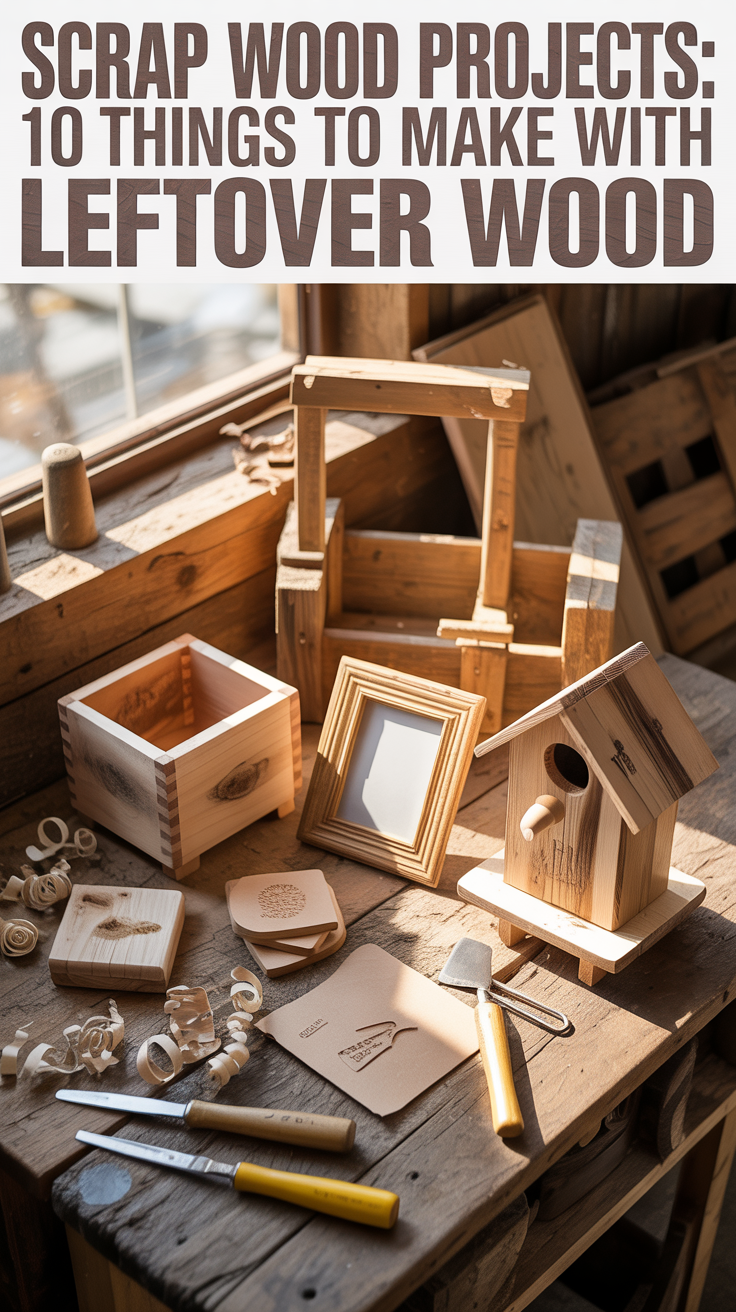
If your offcut bin is overflowing, you’re sitting on a goldmine of creative potential. Scrap wood projects make smart use of leftover wood, help you practice joinery and finishing on a small scale, and turn waste into decor, gifts, and practical organizers. In this guide, we’ll walk through 10 things to make with leftover wood—ranging from super-quick builds to an advanced mosaic table—so you can clean up your shop and make something beautiful. If you want hundreds of step-by-step plans to spark ideas, check out TedsWoodworking.
Before you dive in, keep it safe: wear eye and ear protection, use push sticks at the table saw, clamp work securely for routing and sanding, and keep a clean, well-lit workspace. For more safety guidance, see OSHA’s woodworking safety overview (OSHA). Choosing sustainably sourced lumber and reusing offcuts also supports responsible forestry practices (Forest Stewardship Council).
Table of Contents
Quick scrap wood projects for tiny offcuts
Projects in this section:
- Geometric coasters
- Minimalist phone/tablet stand
- Geometric coasters
What they use best: Small hardwood offcuts (maple, walnut, cherry, oak) and even thin plywood. Mixed species give a striking contrast.
Tools and materials:
- Miter saw or hand saw
- Sandpaper (120–220 grit)
- Wood glue
- Finish: wipe-on poly, tung oil, or Danish oil
- Optional: cork sheet or felt pads
Steps:
- Rip or cut offcuts into uniform strips. Glue contrasting species edge to edge to form a small panel. Clamp until cured.
- Crosscut the panel into squares or hexagons using a stop block for consistency.
- Add a 45-degree chamfer with a block plane or router to soften edges.
- Sand to 220 grit; wipe away dust. Finish with a water-resistant wipe-on poly. Attach cork/felt pads underneath to protect surfaces.
Pro tips:
- Use a simple inlay: cut a shallow kerf and glue in a thin walnut or maple spline for an accent.
- For a modern look, mask a diagonal and apply a dark stain only to one half.
- Minimalist phone/tablet stand
What they use best: A single block of hardwood or laminated scraps measuring roughly 3–5 inches long.
Tools and materials:
- Miter saw or Japanese pull saw
- Handsaw and chisel (or table saw for kerfs)
- Sandpaper, finish
- Optional: leather or rubber to line the slot
Steps:
- Cut a block to roughly 1 x 2 x 4 inches.
- Mark a centered kerf 1/2–3/4 inch deep at a 10–15 degree angle. This sets the viewing angle.
- Saw the kerf, clean up with a chisel, and slightly widen for device cases.
- Ease edges, sand to 220 grit, finish. Add a leather/rubber strip inside the slot for grip.
Pro tips:
- Add a cable pass-through by drilling a small hole in the base behind the slot.
- For tablets, increase the footprint to prevent tipping.
Skill builder benefits: These two small scrap wood projects teach clean crosscuts, glue-ups, edge profiling, and finishing in less than an afternoon—ideal for testing stains and oils on offcuts first. If you’re outfitting a compact workspace, UltimateSmallShop shows space-saving shop layouts and tool setups tailored for small garages or spare rooms.
Entryway and wall storage scrap wood projects
Projects in this section:
- Entryway key rack with shelf
- Chunky floating shelves
- Entryway key rack with shelf
What they use best: Short boards 12–24 inches long and 3–6 inches wide. Mixing species adds visual interest.
Tools and materials:
- Drill/driver, countersink bit
- Pocket hole jig or dowels (optional)
- Wood glue, screws, anchors
- Hooks or pegs, finish, mounting hardware
Steps:
- Design: One backer board and a shallow shelf on top (3–4 inches deep). The backer can be one wide board or laminated strips.
- Attach the shelf to the backer with pocket screws or glue-and-dowels; add a simple triangular brace under each end if needed.
- Drill pilot holes for hooks/pegs. Evenly space them or offset for a staggered look.
- Sand to 180–220. Finish with poly or oil-plus-wax blend.
- Mount securely into studs or with appropriate anchors.
Pro tips:
- Add a lip to the shelf to keep mail/sunglasses from sliding off.
- Laser-engrave or stencil a family name or welcome message.
- Chunky floating shelves
What they use best: Thicker scraps or laminated panels. Plywood or solid wood works.
Approach:
- Build a hollow “box” shelf that slips over a hidden cleat: a cleat screwed into studs, and a U-shaped shelf that slides over it.
- Alternatively, use heavy-duty concealed brackets if you have solid wood shelves.
Steps:
- Mill the face, top, and bottom pieces to the same width. Glue and brad nail to form a U-channel.
- Find studs, level and mount the cleat. Test-fit shelf depth to ensure snugness.
- Slide shelf on; secure with screws through the top into the cleat.
Finishes and styling:
- For a modern look, keep edges crisp and use clear matte poly.
- For rustic shelves, wire-brush the grain and use a medium-brown stain, wiping back to highlight texture.
Shop tip:
- Keep offcuts sorted by length in a simple bin so pairing boards for symmetrical shelves is easy. See our [Beginner’s guide to miter saws](INTERNAL LINK PLACEHOLDER) for accurate crosscutting and clean miters on shelf edges.
Kitchen builds to make with leftover wood
Projects in this section:
- End-grain cutting board
- Rustic serving tray
- End-grain cutting board
What they use best: Hardwood scraps—maple, walnut, cherry, beech. Avoid softwoods and open-pored ring-porous woods for food prep.
Tools and materials:
- Table saw or band saw, clamps
- Random-orbit sander
- Food-safe mineral oil and beeswax
- Wood glue rated for indirect food contact
Steps:
- Mill scraps square and to identical thicknesses. Glue them edge-to-edge into a panel. Clamp evenly to avoid bowing.
- Crosscut the panel into strips, rotate each strip 90 degrees so end grain faces up, then re-glue in the desired pattern.
- Flatten with a planer sled or sanding. Ease edges with a 1/8-inch roundover.
- Raise the grain with a damp cloth, sand to 220 grit, and apply multiple coats of mineral oil. Buff in a beeswax/mineral oil mix.
Safety and hygiene:
- Use known species; some exotics can be irritating or toxic. Check species data at The Wood Database (The Wood Database).
- Follow food-contact guidance for cleaning and sanitizing cutting surfaces (USDA Food Safety and Inspection Service).
- Learn more about [Food-safe finishes for cutting boards](INTERNAL LINK PLACEHOLDER).
- Rustic serving tray
What they use best: Wide board offcuts or glued panels 16–24 inches long.
Steps:
- Square up a panel roughly 12 x 18 inches.
- Add side strips for height (1–2 inches). Mitered corners look polished; butt joints are fine for rustic builds.
- Drill for handles or add black iron pipe handles for an industrial vibe.
- Finish with a durable topcoat (oil-based poly or waterborne poly). If you’ll serve food directly, use a hardwax oil labeled for food contact and always use parchment for messy items.
Design ideas:
- Inlay a thin contrasting strip down the center.
- Torch the surface lightly (Shou Sugi Ban style) and brush back to highlight grain before sealing.
Time-saver tip:
- When you need fast, reliable dimensions and cut lists for these popular kitchen builds, curated plan sets in TedsWoodworking can speed up your layout and reduce mistakes.
Garden and outdoor ideas from leftover wood
Project in this section:
- Garden planter box
- Garden planter box
What they use best: Fence pickets, cedar offcuts, pallet slats (confirm heat-treated pallets only), and exterior-rated plywood.
Tools and materials:
- Circular saw or miter saw
- Exterior wood screws, waterproof glue
- Drill/driver, countersink
- Exterior finish (spar urethane) or penetrating oil
- Landscaping fabric or plastic liner with drainage holes
Steps:
- Size and design: A simple 24 x 12 x 12-inch box fits most patios. Use cedar for rot resistance. Rip slats to consistent widths for clean lines.
- Build side panels: Edge-glue slats or screw them to interior cleats. Make two long sides and two short sides.
- Assemble the box: Screw panels together through corner posts or use half-lap corners for strength.
- Add a bottom: Slats with 1/4-inch gaps for drainage. Reinforce with interior cleats if the box is large.
- Line and finish: Staple landscaping fabric or a perforated plastic liner. Finish with an exterior oil or spar urethane.
Options:
- Add feet to elevate the box and reduce moisture wicking.
- Create a self-watering insert with a perforated false bottom and fill tube.
- Build a matching set in graduated sizes for a cohesive patio look.
If outdoor builds are your thing and you’re running out of storage space, a small garden shed or potting bench might be your next weekend project. For full-size outdoor structures, browse plan sets in My Shed Plans to keep your tools and materials organized and protected from the elements.
Home decor from offcuts and short boards
Project in this section:
- Mitered picture frames
- Mitered picture frames
What they use best: Narrow strips of hardwood, unique grain offcuts, and small lengths that might otherwise be tossed.
Tools and materials:
- Miter saw or miter box
- Spline jig or V-nails (optional)
- Glass or acrylic, backing board, hanging hardware
- Finish of choice
Steps:
- Rip consistent frame stock (e.g., 1–1.5 inches wide, 3/4 inch thick). Add a 1/4-inch rabbet on the back with a router table or table saw for the glass and artwork.
- Cut four 45-degree miters. Dry-fit, then glue and clamp with a band clamp. Reinforce joints with splines or V-nails for larger frames.
- Sand to 220, finish with clear lacquer for a modern look or stain for a classic tone.
- Install glass/acrylic, mat, print, and backing board. Attach D-rings or a wire for hanging.
Design ideas:
- Use bookmatched strips for symmetrical frames.
- Create a gallery set with varied widths and species, unified by a shared finish.
Accuracy tip:
- When cutting miters, creep up on the angle and test with scrap first. A simple miter-shooting board helps fine-tune perfect 90-degree corners. See our [Beginner’s guide to miter saws](INTERNAL LINK PLACEHOLDER) for setup and calibration.
Finish tip:
- Oil-based finishes warm up cherry and walnut; waterborne clears keep maple bright. Not sure which to choose? Start with our [How to choose the right wood finish](INTERNAL LINK PLACEHOLDER).
Cozy lighting from small blocks and strips
Project in this section:
- Tea light candle holders
- Tea light candle holders
What they use best: Short blocks and laminated strips. Dense hardwoods like maple or walnut look premium.
Tools and materials:
- Forstner bit sized to tea lights (commonly 1-1/2 inch or 38 mm)
- Drill press or hand drill
- Sandpaper, finish
- Optional: epoxy for inlay
Steps:
- Size your block: a simple 2 x 2 x 6-inch bar holds three lights; a single 2–3-inch square block holds one.
- Mark hole spacing and drill to a depth that leaves 1/4 inch of material below the candle.
- Chamfer or round over edges. Sand to 220 grit.
- Finish with heat-tolerant options: shellac then wax, or a durable poly. Avoid sticky finishes that can soften with heat.
Safety notes:
- Never leave candles unattended. Ensure adequate thickness below the cup, and consider using LED tea lights for zero-heat ambiance.
- Some exotic species may not be suitable when heated. Check species safety notes at The Wood Database (The Wood Database).
Creative variations:
- Inlay a thin strip of contrasting wood or metallic epoxy between holes.
- Cut a gentle arc on the front face for a sculptural profile.
If you’re crafting lots of small decor items and wondering how to sell them at craft fairs or online, WoodProfits offers guidance on pricing, product selection, and setting up a simple side income stream from your shop.
Advanced upcycle: end‑grain mosaic side table
Project in this section:
- End-grain mosaic side table or stool
- End‑grain mosaic side table or stool
What it is: A statement piece that turns tiny end-grain blocks into a striking “tile” surface—perfect for using up lots of hardwood scraps.
Tools and materials:
- Table saw or band saw, crosscut sled
- Clamps, cauls
- Waterproof wood glue
- Plywood substrate
- Router with flush-trim bit
- Finish: hardwax oil or poly
- Optional: premade metal hairpin legs or a simple wood base
Steps:
- Prepare the blocks: Mill hardwood offcuts to the same thickness, then crosscut into small end-grain tiles (e.g., 3/4 x 3/4 x 2 inches). Vary species for contrast.
- Substrate: Cut a plywood top slightly oversize (e.g., 16–18 inches diameter for a round top, or 16 x 16 inches square).
- Glue the mosaic: Spread glue on the substrate and set blocks tightly together in your chosen pattern. Work in sections so glue doesn’t skin over. Clamp with cauls and weights to keep blocks flat.
- Trim and flatten: Once cured, flush-trim edges with a router and lightly sand. If the surface is uneven, plane with a sled or use a heavy sanding routine with a flat sanding block.
- Edge banding: Add a solid wood band around the perimeter for a refined look; glue and clamp, then flush-trim.
- Base: Attach hairpin legs or build a simple trestle base from longer leftover pieces.
- Finish: Seal with hardwax oil for a tactile, repairable surface, or multiple coats of polyurethane for high durability.
Tips for success:
- Sort blocks by height to minimize leveling work after glue-up.
- Alternate grain orientation and species for a vivid checker or herringbone mosaic.
- Avoid softwoods and oily exotics that complicate glue bonds. If you must use oily species, wipe mating surfaces with acetone before gluing and consider [Wood glue vs. epoxy](INTERNAL LINK PLACEHOLDER) for reliable adhesion.
Sustainability and longevity:
- This project diverts a surprising amount of material from the trash while yielding a premium piece you’ll use for years. Keep end-grain tops conditioned and avoid direct standing water for best durability.
Simple scrap wood projects to make with leftover wood
At this point you’ve seen ten builds that put offcuts to work—from five-minute coasters to a furniture-grade mosaic table. Here’s a quick recap and planning notes to keep your scrap bin productive:
- Sort by thickness and species. It speeds up glue-ups for coasters, frames, and cutting boards.
- Batch tasks. Crosscut all coaster blanks, then sand and finish in one session to save time.
- Keep a small hardware box of handles, hooks, hinges, and feet; these low-cost add-ons turn simple boards into sellable products.
- Finish smart. For food-contact items, stick to mineral oil and beeswax or a product clearly labeled food-safe. For decor, choose wipe-on poly for ease and durability.
If you want a library of beginner-to-advanced plans that make the most of your materials, browse TedsWoodworking. And if you’re stepping up your shop’s efficiency in a small space, UltimateSmallShop can help you arrange tools, dust collection, and storage so working with scraps is organized and safe.
Conclusion
Turning leftovers into useful builds is one of the most satisfying parts of woodworking. With these Scrap Wood Projects: 10 Things to Make with Leftover Wood, you’ll turn the pile in your offcut bin into gifts, home upgrades, and even a showpiece table—while practicing essential skills and reducing waste. Keep your scrap sorted, your edges square, and your finish routine simple, and you’ll never look at “waste” the same way again.
FAQ
What are the best scrap wood projects to make with leftover wood?
Start with small, high-impact builds that use tiny offcuts: coasters, phone stands, key racks, tea light holders, and picture frames. With medium-length scraps, step up to floating shelves and serving trays. Save hardwoods for cutting boards and an end‑grain mosaic table.
Is it safe to use leftover wood for cutting boards?
Yes—if you use closed-grain hardwoods like maple, walnut, cherry, or beech and a food-safe finish such as mineral oil and beeswax. Avoid softwoods and unknown or potentially toxic species. Clean and sanitize properly following USDA guidance (USDA Food Safety and Inspection Service).
How do I join short boards for shelves or trays?
Edge-glue matching thicknesses using cauls to keep panels flat. For added security, use biscuits, splines, or dowels, though good edge prep and clamping are usually enough. Sand flat, then finish with a durable topcoat.
What finishes work best for scrap wood projects?
Food-contact: mineral oil + beeswax, or a certified hardwax oil.
Decor and furniture: wipe-on polyurethane, Danish oil, or shellac. Waterborne poly keeps light woods bright; oil-based warms darker species.
What tools do I need to start?
You can do most of these with a miter saw, drill/driver, sander, clamps, and hand tools. A table saw and router expand your options (rabbets, roundovers, and splines). If space is tight, UltimateSmallShop offers layouts and tool recommendations for compact shops.