
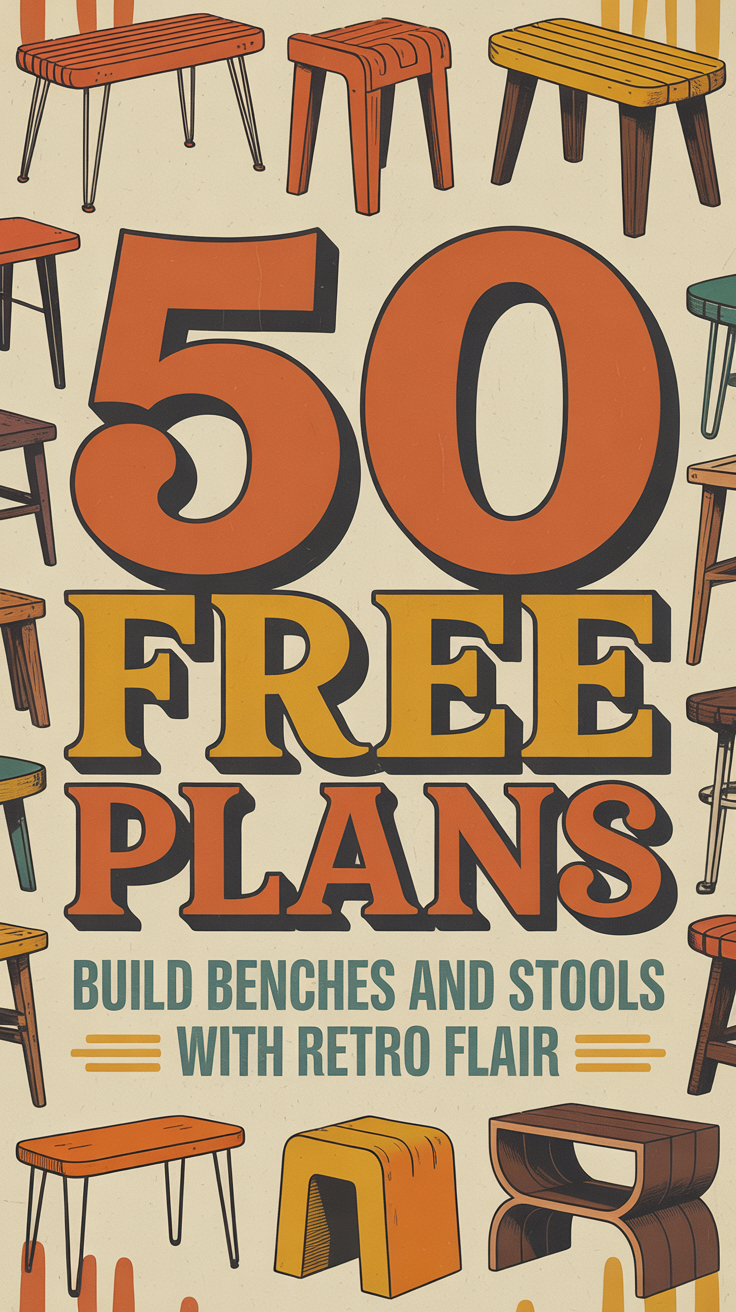
If you’ve been itching to mix mid-century lines, vintage colorways, and classic joinery into quick, satisfying builds, this is your one-stop guide. Below you’ll find 50 free plans to build benches and stools with retro flair, plus tool tips, wood choices, finish ideas, and a complete step-by-step example. Whether you’re furnishing a breezy porch, injecting personality into a studio apartment, or producing small-batch pieces to sell, these designs emphasize clean geometry, rounded profiles, tapered legs, hairpin accents, and durable finishes that stand the test of time.
Get an all-in-one plan vault to complement the free designs here: TedsWoodworking. It’s a useful backup when you want alternative cut lists, joinery diagrams, or inspirations beyond benches and stools.
Safety note: Always use eye and ear protection, keep blades sharp, and support work properly. For general shop safety and PPE guidance, see OSHA’s Eye and Face Protection overview.
Table of Contents
How to use these 50 free plans: Build benches and stools with retro flair
Before you dive into the designs, align your build goals with your skill level, tools, and time. Retro-inspired benches and stools lean heavily on simple geometric forms and strong, repeatable joinery. That means beginners can achieve great results using pocket screws or dowels, while intermediate builders might enjoy mortise-and-tenon or floating tenons. Keep these guidelines in mind:
- Match the space and purpose: Dining benches typically run 16–18 inches high with 12–16 inches of depth. Entryway benches can be slimmer if your hall is tight. Vanity or counter stools target 24–26 inches high; bar stools 28–30 inches. See general height guidelines summarized by The Spruce .
- Don’t skimp on lumber prep: Retro lines look best when edges are crisp and surfaces flat. Mill lumber consistently, break sharp edges slightly, and pre-sand to 150–180 grit before assembly to save time later.
- Pick a joinery path: Retro silhouettes favor visible structure (think leg stretchers or undercarriage rails). Pocket screws can be hidden with plugs; dowels keep the look minimal; traditional mortise-and-tenon adds long-term strength.
- Favor stable woods: Poplar, maple, beech, ash, and oak take paint and clear finishes well. For outdoor use, consider white oak, cypress, or teak with a UV-protective finish.
- Color and hardware choices make the style: Angled tapers, hairpin legs, capped feet, and two-tone finishes are retro signatures. Brass or matte black hardware pairs well with saturated colors.
If you’re newer to woodworking, start with a compact bench or backless stool. Work through a single build, then repeat it with small variations in finish, leg angle, or edge radius. Repetition builds skill quickly while staying within the retro aesthetic.
Essential tools and lumber for 50 free plans: Build benches and stools with retro flair
Keep your tool kit lean but efficient. Retro seating often uses square stock, controlled tapers, consistent roundovers, and precise joinery that can be achieved with basic tools. Here’s a practical lineup:
- Cutting and shaping: Circular saw or table saw for ripping to width; miter saw for crosscut accuracy; jigsaw or bandsaw for curves; a block plane and rasps for refining edges and shaping tapers.
- Joinery: Pocket-hole jig for quick structural assembly; dowel jig or self-centering dowel jig for concealed strength; chisels and a router for mortises; optional domino or slot mortiser for production speed.
- Drilling and sanding: Cordless drill/driver, drill press if available; random-orbit sander with 80/120/150/180 grits; sanding block for final touch-ups.
- Measuring and layout: Combination square, marking knife, bevel gauge for leg angles; story sticks for repeatability across multiple builds.
- Finishing: Foam and natural bristle brushes, small foam rollers for large flats, HVLP sprayer if you go high-volume; painter’s pyramids and racks for efficient drying.
Material picks:
- Indoors: Maple or beech for smooth paint finishes; oak and ash for visible grain; birch plywood for budget-friendly tops with edge-banding.
- Outdoors: White oak, teak, ipe, or thermally modified ash with marine-grade exterior finishes.
- Accents: Steel hairpin legs, threaded inserts for removable legs, reproduction ferrules, or brass caps.
Space and workflow matter just as much as tool choice. If you’re outfitting a compact garage or spare room, optimizing storage, dust collection, and workflow will multiply your productivity and accuracy. See how to design a smart micro-shop and stretch your budget with UltimateSmallShop – The Next Woodworking Blockbuster!. A thoughtfully arranged bench, fence, and clamping layout can cut your build time by a third.
For deeper reading on moisture, wood movement, and stability, the USDA Forest Products Laboratory Wood Handbook is an essential, free reference.
The 50 free plans catalog: benches, stools, and accents with retro charm
Use this curated list as your buildable blueprint library. Each entry indicates a quick concept, hallmark retro features, recommended joinery, and a suggested finish direction. Adapt dimensions to your space.
Benches (1–20)
- Mid-century slat bench, low profile; dowel or pocket joinery; clear oil on ash.
- Hairpin-leg bench with rounded maple top; threaded inserts; satin lacquer.
- Angled-taper leg bench with stretcher; mortise-and-tenon; walnut oil-wax.
- Box-frame bench with plywood seat; pocket screws; matte color lacquer.
- Shaker-meets-retro hall bench; wedged through-tenons; soap finish on oak.
- Floating top bench with shadow reveal; z-clips; waterborne poly.
- Vinyl-upholstered cushion bench; pocket screws; atomic-era color piping.
- Shoe-cubby entry bench with radiused edges; dados + screws; enamel paint.
- Two-plank bench with breadboard ends; tenons + pegs; blonde shellac.
- Boomerang corner bench; spline-miter corners; tinted varnish.
- Metal strap-leg bench with wood seat; bolt-through joinery; black enamel legs.
- Split-top bench with center magazine slot; dowels; oiled beech.
- Spindle-back settle bench; round mortise-and-tenon; milk paint + clear coat.
- Slab-top bench with steel C-channel; threaded inserts; satin hardwax oil.
- Parsons-style bench with thin reveal; domino or loose tenons; matte urethane.
- A-frame leg bench; half-lap joinery; open-pore grain finish.
- Angled-box bench with hidden storage; piano hinge; color-block paint scheme.
- Danish cord seat bench on tapered legs; mortise-and-tenon; oil-wax.
- Folding bench with scissor legs; through-bolts; wipe-on poly.
- Outdoor retro garden bench with splayed legs; exterior screws + plugs; marine spar varnish.
Stools (21–40)
21) Three-leg milking stool with round seat; wedged tenons; colored dye + oil.
22) Square shop stool with footrest; pocket screws; polyurethane.
23) Low ottoman-style stool; dowels; fabric cushion in mustard or teal.
24) Tractor-seat stool with carved seat; through tenons; oil-varnish blend.
25) Hairpin-leg counter stool; insert nuts; powder-coated legs.
26) Hex stool with 30° facets; spline miters; clear conversion varnish.
27) Retro step-stool with flip-up step; dados and hinges; enamel two-tone.
28) Bent-ply laminated stool; vacuum bag or form; waterborne clear.
29) Pie-slice multi-stool set forming a circle; dowels; pastel paints.
30) Folding camp stool with leather sling; bolts and T-nuts; oil on frames.
31) Turned-leg vanity stool; round mortises; shellac.
32) Minimalist plywood L-stool; rabbet joints; durable floor varnish.
33) Crescent-seat bar stool; domino tenons; black stain + topcoat.
34) Stackable shop stools with handholds; pocket screws; scuff-proof satin.
35) Cork-topped stool; screws from below; hardwax oil on cork-friendly finish.
36) Triangular seat with radiused corners; dowels; color-dipped legs.
37) Tall draughtsman stool with circular footring; threaded inserts; lacquer.
38) Upholstered mushroom stool; cleats and staples; fabric in retro prints.
39) Windsor-inspired counter stool; tapered round tenons; oil finish.
40) Outdoor patio stool in white oak; stainless screws + plugs; exterior oil.
Side tables, accents, and hybrids (41–50)
41) Slat bench-table hybrid; dowels + clips; satin poly.
42) Magazine-sling bench with leather cradle; rivets + cleats; oil finish.
43) Record-player bench stand; pocket screws; walnut dye + oil.
44) Entry bench with coat pegs; screw-in pegs; color-pop accents.
45) Planter-bench combo with removable box; pocket screws; exterior finish.
46) Double X-leg bench; half-laps; colored wax.
47) Waterfall plywood bench with exposed edge; miters + spline; clear coat.
48) Retro TV-bench stand; dados + rabbets; matte enamel.
49) Radiused-corner storage bench; kerf-bending; waterborne polyurethane.
50) Slatted shoe bench with angled end panels; domino tenons; oil-wax.
Treat each entry like a light blueprint: sketch the outline, settle dimensions, and build a quick cut list. Add a 3–5 degree splay to legs for that unmistakable mid-century posture, soften edges with a 1/8-inch roundover, and keep stretchers high enough for comfortable foot clearance.
Step-by-step walkthrough: build a mid-century slat bench
This build is a staple of retro interiors: a low-profile slat bench with tapered legs, a floating look, and a durable clear finish.
Overall dimensions
- 48 inches long x 14 inches deep x 16–17 inches high
- 1×2 or 1×3 slats (actual ~0.75 x 1.5/2.5 inches)
- Four legs, tapered on two faces, splayed 3 degrees
Cut list (adjust as needed)
- Slats: 10–12 pieces at 48 inches (1×2 or 1×3)
- Long aprons: two at 44 inches (1×3)
- Short aprons: two at 10 inches (1×3)
- Stretchers: optional, two at 10 inches (1×2)
- Legs: four at 16–17 inches, 1.5–1.75 inches square stock
Tools and materials
- Saw (miter or table), pocket-hole jig or dowel jig, router with 1/8-inch roundover, sander, clamps
- 1-1/4 to 1-1/2 inch screws (if using pocket holes), wood glue
- Finish: oil + satin topcoat or hardwax oil
Build sequence
- Prepare aprons and legs: Mill stock square. Cut aprons to size. Lay out leg tapers: remove roughly 1/4 inch over the bottom 8–10 inches on two adjacent faces. Cut tapers at the bandsaw or with a taper jig on the table saw, then clean up with a plane or sander. Add a slight 3-degree bevel at the top of each leg if you’re splaying outward.
- Join the base: Choose pocket screws for speed (holes on the inside faces of aprons) or dowels/loose tenons for a clean look. Glue and clamp the rectangular apron frame square; check diagonals. Attach legs to the inside corners with your joinery of choice. For pocket screws, use corner blocks glued inside each corner for added strength.
- Dry fit the slats: Space evenly along the top with 1/2-inch gaps (use spacers). Mark screw locations or dowel positions. For a floating look, add low-profile cleats to the inside of aprons and mount the slats to the cleats instead of the aprons themselves.
- Shape and sand: Add a 1/8-inch roundover to exposed edges of slats and aprons. Break sharp corners by hand. Sand through 120–150–180 grits. Lightly ease the leg tips for a refined grounded look.
- Glue-up and assembly: If using dowels, predrill. Otherwise, apply a small dab of glue under each slat and secure with screws from below through cleats or aprons. Keep everything aligned with spacers.
- Finish: Wipe on oil to pop grain (especially on ash or oak). After curing, add two to three thin coats of waterborne polyurethane or hardwax oil. For a color accent, dip the bottom 1–2 inches of each leg in a contrasting retro color (mustard, coral, turquoise); mask carefully for a crisp line.
- Optional upgrades: Add threaded inserts under the apron corners for removable legs. Install felt pads or brass caps. Integrate a narrow magazine slot by omitting one slat and creating a small rectangular gap.
Tips for strength and longevity
- Don’t exceed 16 inches between leg centers for a 3/4-inch slat top without additional stretchers.
- Use longer aprons (1×4) if you need extra stiffness.
- Keep slat spacing consistent with a dedicated spacer block to improve visual rhythm—a key retro hallmark.
Joinery, ergonomics, and strength for long-lasting seating
Great-looking retro seating should also feel solid and supportive. Focus on three dimensions: height, seat depth, and leg geometry. For backless benches, 16–18 inches high and 12–16 inches deep works for most people; for stools, match the seat height to the counter or table height with 9–12 inches of clearance. A bar at 42 inches calls for a 30-inch stool; a counter at 36 inches pairs with a 24–26 inch stool. See additional guidance at The Spruce and adjust for cushions.
Joinery best practices
- Pocket screws: Fast, strong in shear, ideal for hidden apron joints. Back them up with glue and consider plugs where the holes are visible.
- Dowels: Simple tools, clean results. Use a self-centering jig and test fit before gluing. Two dowels per apron joint increase resistance to racking.
- Mortise-and-tenon: Gold standard for high-load stools, especially with splayed legs. Through tenons and wedges nod to vintage craftsmanship while boosting strength.
- Hardware and inserts: Threaded inserts plus machine bolts are perfect for removable legs and knockdown builds, especially when shipping or selling.
Geometry for stability
- Splay: A 2–5 degree splay adds stability and retro stance without complicating the build. Maintain consistent angles on all legs with a bevel gauge.
- Stretchers: Footrests on stools double as anti-racking members. Place them 8–12 inches off the floor for counter stools, slightly higher for bar stools.
- Overhangs: Keep seat overhang to 1–1.5 inches beyond aprons for a clean floating effect without inviting tip risk.
Wood science matters
- Acclimate your lumber: Let wood reach equilibrium moisture content before milling. Check the free Wood Handbook (USDA FPL) for regional targets.
- Grain orientation: For slats and narrow seats, orient growth rings consistently to reduce cupping. Biscuits or splines add alignment, not structural strength—plan accordingly.
Finishes and colorways for 50 free plans: Build benches and stools with retro flair
Retro style lives and dies by the finish. You can keep the wood front-and-center with a warm oil tone and satin sheen, or you can push color boldly with enamel paints and two-tone legs. Popular palettes include mustard yellow, avocado green, robin’s-egg blue, coral, and matte black or brass accents. Consider these approaches:
Natural looks
- Oil + hardwax oil: Simple, repairable, and tactile. Great on oak, ash, and walnut. Burnish between coats for a velvety feel.
- Waterborne polyurethane: Clear, non-yellowing, low odor. Ideal if you want the wood’s natural color preserved on maple or birch.
- Shellac: Amber warmth and fast build; top with a more durable varnish for seating.
Color-forward finishes
- Enamel paint over primer: Smooth, period-correct sheen. Practice leveling with a foam roller or sprayer.
- Color-dipped legs: Mask 1–2 inches of leg tips and paint in a high-contrast retro color.
- Two-tone frames: Natural wood top with painted aprons/legs in a mid-century hue.
Durability tactics
- Prep is 80% of finishing: Sand to at least 180 grit. Vacuum dust and wipe with a tack cloth. Practice on scrap with the exact sequence.
- Edge protection: Rounded edges (1/8-inch) resist chipping and feel more refined to the touch.
- Outdoor care: Use UV-inhibiting exterior finishes. Maintain annually with a light scuff and recoat.
For technique depth, Fine Woodworking’s finish archives provide reliable theory and tests. When in doubt, make a finish sample board with three labeled columns: “one coat,” “final finish,” and “touch-up.” This removes guesswork when you repeat a design for gifts or for sale.
Pro workflow idea: set up a finishing day. Batch all sanding to 180 grit, mask hardware areas, and spray or roll coats for multiple builds at once. Retro pieces shine when their finishes are uniform across a small collection.
Tools for production and repeatability
If you plan to build multiple benches and stools, small investments in repeatability save time and yield cleaner results.
- Jigs and fixtures: A tapering jig, a drilling jig for leg angles, and a router template for rounded seats transform consistency. Build a simple drill guide block that sets your leg splay angle, and you’ll get identical stools every time.
- Story sticks: Mark apron lengths, stretcher positions, and hole locations on a hardwood stick. Faster than measuring each time, and fewer errors.
- Batch cutting and labeling: Cut all legs at once, label parts on painter’s tape, and keep components grouped in bins.
- Dust and finishing stations: Good dust extraction improves finish quality. If space is tight, a mobile cart with a shop vac and cyclone separator keeps air clearer.
When you’re squeezing a pro-grade workflow into a spare bay or shed, smart layout and tool choice matter. For a concise blueprint to plan, equip, and wire a compact shop that still handles furniture builds, check out UltimateSmallShop – The Next Woodworking Blockbuster!. It focuses on getting the most out of limited space and budget, which is perfect when you’re churning out retro seating on evenings and weekends.
Batch-finishing tip: Align multiple stools on painter’s pyramids, then spray or roll in a single pass. Keep a wet edge and work in logical segments—undersides first, then tops—to reduce handling marks.
Turn your hobby into income with small-batch retro seating
Retro benches and stools make excellent market-ready products: they’re compact, materials are affordable, build time is reasonable, and the style photographs well. Here’s a quick roadmap:
Design tight, repeatable SKUs
- Choose two stools and two benches from the 50 free plans and refine them through two prototype cycles.
- Standardize finishes and hardware. Offer two colorways max (e.g., natural + brass, or matte black + coral tips).
- Create a sizing cheat sheet (seat height, width, depth) and post those specs for customers.
Material and shop efficiency
- Buy lumber in standard lengths you can optimize across multiple SKUs to minimize waste.
- Cut and mill for two to four units at a time.
- Keep a dedicated “finishing bin” with your exact brushes, rollers, masks, and rags for each SKU.
Pricing and selling
- Track time and materials for your prototypes; add a reasonable hourly rate and a margin for overhead.
- Photograph in natural light with a simple retro backdrop—plants, record player, or patterned rug—to match the vibe.
- Sell locally first: craft fairs, pop-ups, and social media. Shipping stools is doable with knockdown legs and flat-pack packaging (thanks to threaded inserts).
Customer delight
- Provide felt pads, a small care card, and a QR code linking to a maintenance guide and assembly video.
- Offer a “color dip” add-on and a cushion option to raise average order value.
If turning weekend builds into a side business sounds exciting, read practical guidance on pricing, sourcing, and selling with WoodProfits. It’s a helpful overview for makers transitioning into commerce.
Quick CTA to get building now
- Want printable diagrams to complement these designs? Pair this guide with TedsWoodworking for thousands of additional plan ideas you can adapt to retro styles.
Recommended resources
- TedsWoodworking: Plan vault to expand beyond these 50 builds.
- UltimateSmallShop – The Next Woodworking Blockbuster!: Compact workshop blueprint.
- WoodProfits: Intro to monetizing your builds.
Conclusion
From the slat bench classic to stackable stools that transform a small space, these 50 free plans: build benches and stools with retro flair are your springboard to durable, beautiful seating. Start with the step-by-step slat bench, then explore the catalog to find your signature style—hairpin legs, tapered profiles, or bold color dips. With smart joinery, ergonomic dimensions, and thoughtful finishing, you’ll craft pieces that look iconic and perform for decades. And if you’re ready to level up, pair this collection with a tidy micro-shop setup and a simple business plan to turn your designs into a trusted local brand.
FAQ
What’s the ideal height for a counter stool?
Counter stools typically sit 24–26 inches high for a 36-inch counter, leaving 10–12 inches of legroom. Adjust 1 inch up or down for cushion thickness.
How thick should a bench top be for strength?
A 3/4-inch top works with close aprons or slats and short spans; go 1 inch or add stretchers for longer benches or heavy-duty use.
Which joinery is best for beginners following these 50 free plans?
Pocket holes are fastest, while dowels offer a clean look with simple tools. Use mortise-and-tenon or loose tenons as you gain confidence.
Can I build outdoor versions of these retro benches and stools?
Yes. Use rot-resistant woods (white oak, teak, cypress) and UV-protective exterior finishes. Stainless screws and plugged holes boost longevity.
How do I get the “retro flair” look without buying specialty legs?
Use leg tapers (3–5 degrees), color-dipped feet, rounded seat corners, and thin reveals between tops and aprons. Subtle angles and contrast colors cue the mid-century style.