
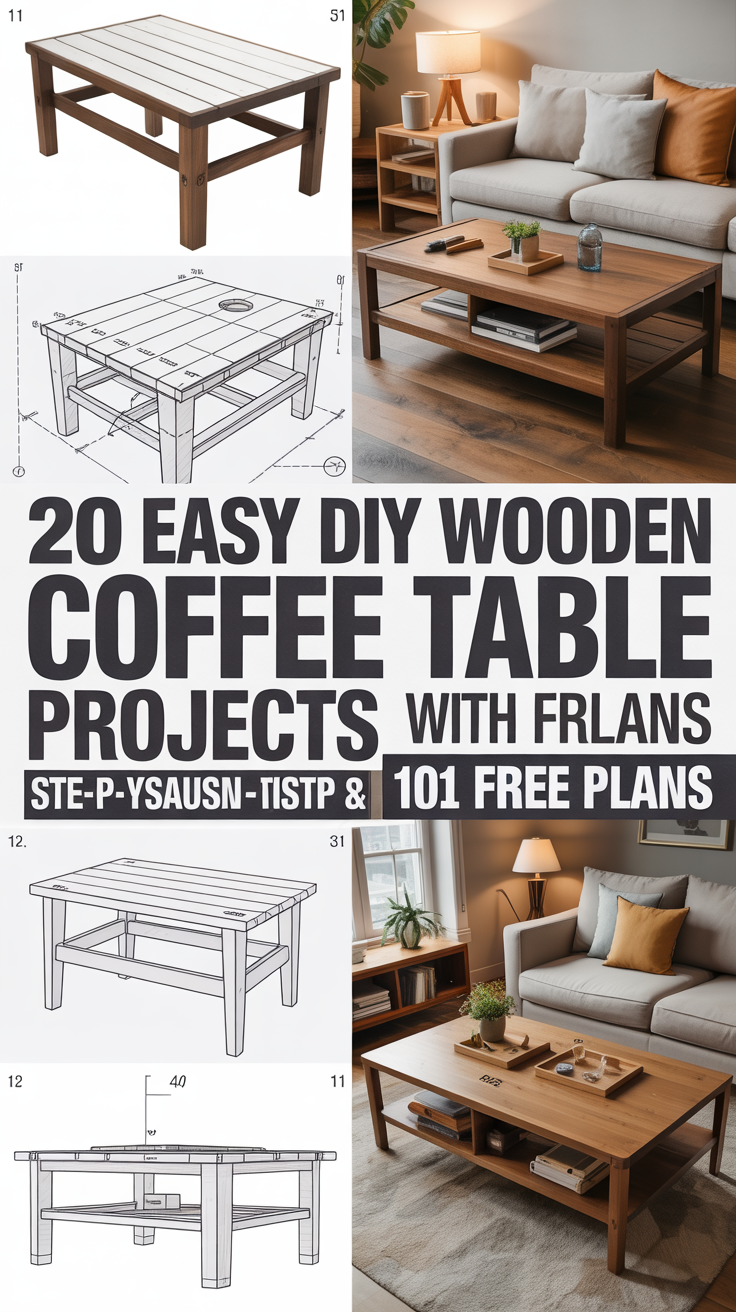
Whether you’re furnishing your first apartment or refreshing a living room on a budget, this curated list of 20 easy DIY wooden coffee table projects with free plans will help you build a beautiful centerpiece without stress. The builds are grouped by style and skill level, and each project highlights key materials, joinery, and finish ideas—plus where to find a free plan to follow step by step.
If you want a master library of printable furniture plans to complement the free options below, grab the massive plan bundle at TedsWoodworking. It’s a time-saver when you need alternate sizes or quick cut lists.
Tip: If you’re brand new to woodworking, start with straight cuts, pocket-hole joinery, and simple glue-ups.
Table of Contents
20 Easy DIY Wooden Coffee Table Projects with Free Plans: 2×4 Builds
2x4s are inexpensive, easy to find, and surprisingly strong. These beginner builds need minimal tools, look great, and can be finished rustic or modern.
1) Classic 2×4 Parsons Coffee Table
- What it is: A clean-lined rectangular table made from 2×4 legs and aprons, topped with edge-glued boards or a plywood panel.
- Why it’s easy: Straight cuts, butt joints or pocket holes, and no tricky angles.
- Build notes: Use a pocket-hole jig to attach aprons to legs; add a central stretcher for stability. Glue and clamp the top, or use a single plywood sheet with a hardwood edge band.
- Finish: Sand to 180–220 grit, stain to taste, and seal with water-based polyurethane for durability.
- Free plan: Look for “Parsons coffee table free plan” on Ana White or BuildSomething by Kreg.
2) Simple Slatted Top 2×4 Table
- What it is: A slatted top adds texture, prevents water rings on patios, and simplifies glue-ups.
- Why it’s easy: Repeatable cuts and uniform spacers create an even top without complicated joinery.
- Build notes: Rip 2x4s to 3″ for a cleaner look. Use 1/4″ spacers between slats, screw down from below through cleats. Add a lower stretcher to minimize racking.
- Finish: Exterior oil if used outdoors; interior polyurethane for living rooms.
- Free plan: Search “DIY slat coffee table free plan” on Family Handyman or Rogue Engineer.
3) Narrow Apartment 2×4 Table
- What it is: A slim table (e.g., 40–48″ x 16–18″) meant for tight rooms and small sofas.
- Why it’s easy: Same techniques as above, just a narrower footprint and lighter top.
- Build notes: Keep legs at 16–18″ height, apron 3–4″ high. Consider a plywood top with mitered frame for a refined edge while staying beginner-friendly.
- Finish: Two-tone paint and stain or natural oil for a Scandinavian vibe.
- Free plan: Find “narrow coffee table free plan” on Shanty 2 Chic or BuildSomething.
Skill boosters:
- Clamp squarely and check for twist before attaching tops.
- Snipe-free edges and flush joints start with careful planing or sanding.
Rustic farmhouse and pallet-inspired tables
These builds celebrate character: visible grain, knots, and chunkier frames with classic X-braces or simple pallet boards.
4) Farmhouse X-Frame Coffee Table with Lower Shelf
- What it is: A timeless X-brace design with a sturdy shelf for baskets and books.
- Why it’s easy: Straight cuts, pocket holes, and well-documented plans.
- Build notes: Cut X pieces slightly long, mark and trim for a perfect fit. Assemble the base first, then add slats for the shelf and top. Consider adding corner blocks for strength.
- Finish: Pre-stain wood conditioner on pine; then a warm stain like walnut and matte poly for that farmhouse look.
- Free plan: Search “X farmhouse coffee table free plan” on Shanty 2 Chic or Ana White.
5) Pallet Deck-Board Top Coffee Table
- What it is: A budget-friendly table using reclaimed pallet boards on a simple 2×4 frame.
- Why it’s easy: Free material and forgiving rustic style—character wins.
- Build notes: Pry apart pallets carefully and remove nails; mill boards flat if you can. Alternate board widths for visual interest; screw into cleats from below.
- Finish: Wire-brush, then seal with water-based poly or oil. Mind splinters; sand edges well.
- Free plan: Try “pallet coffee table free plan” on Instructables.
6) Chunky Baluster-Leg Farmhouse Table
- What it is: A classic top with chunky turned legs or 4×4 posts for presence.
- Why it’s approachable: The legs do the heavy lifting aesthetically; the joinery remains simple.
- Build notes: Use pocket holes to join aprons to legs; add corner braces. For the top, glue boards, clamp flat with cauls, then attach with figure-eight fasteners to allow wood movement.
- Finish: Hand-scrape edges and add a distressed finish for character.
- Free plan: Search “baluster leg coffee table plan” on BuildSomething or Rogue Engineer.
Materials note: Consider wood species hardness and movement when choosing tops. The Wood Database is an excellent reference for density, stability, and finishing behaviors (The Wood Database).
Modern plywood, box, and hairpin-leg tables
Minimalist silhouettes and clean edges dominate these projects, with easy-to-source materials like plywood and prefabricated hairpin legs.
7) Plywood Waterfall Coffee Table
- What it is: A single panel “waterfalling” over the edges so grain runs continuously down the sides.
- Why it’s approachable: Mostly mitered cuts and glue; fewer parts to assemble.
- Build notes: Cut a sheet into top and sides and bevel edges to 45°. Use biscuits or splines for alignment at miters. Clamp with band clamps, then add a central stretcher inside for rigidity.
- Finish: Veneer tape any exposed edges, sand gently, then finish with satin poly or hardwax oil.
- Free plan: Search “waterfall plywood coffee table free plan” on Home Depot DIY or Popular Woodworking.
8) Mid-Century Hairpin-Leg Slab Table
- What it is: A slab or panel top paired with metal hairpin legs for a mid-century feel.
- Why it’s easy: The base is premade—just prep the top, attach legs, and finish.
- Build notes: Edge-glue boards or use a live-edge slab (sanded flat). Add threaded inserts for removable legs. Consider a chamfered underside for a thinner visual edge.
- Finish: Clear oil to highlight grain; paste wax for a silky feel.
- Free plan: Search “hairpin leg coffee table free plan” on Family Handyman or BuildSomething.
9) Plywood Storage Cube Coffee Table on Casters
- What it is: A hollow cube with open shelves or bins—great for blankets and remotes.
- Why it’s approachable: Straight cuts, simple butt or rabbet joints, and a boxy aesthetic.
- Build notes: Use a cutting diagram to maximize sheet yield. Rabbets increase glue surface; pin-nail and clamp. Add locking casters for mobility.
- Finish: Edge-band exposed plywood and seal with polyurethane for durability.
- Free plan: Try “plywood cube coffee table free plan” on Kreg’s BuildSomething.
Tool tip: A small space shop can handle all of these with a circular saw, drill/driver, and sander. For compact, budget-friendly shop setups and jigs, see UltimateSmallShop – The Next Woodworking Blockbuster!.
More Easy DIY Wooden Coffee Table Projects with Free Plans: Storage Ideas
Hidden storage keeps your living room tidy. These builds add organization without complicating the woodworking.
10) Lift-Top Coffee Table with Hidden Compartment
- What it is: A tabletop that rises to desk height, revealing storage below—ideal for laptops and meals.
- Why it’s approachable: Off-the-shelf lift-top hardware does the heavy lifting.
- Build notes: Build a sturdy box carcass; attach the lift mechanism per instructions. Balance the weight with a lighter top (plywood + edging works well). Test hinges before final finish.
- Finish: Durable topcoat like semi-gloss poly; lift surfaces see frequent contact.
- Free plan: Search “lift top coffee table free plan” on Family Handyman.
11) Two-Drawer Coffee Table
- What it is: A rectangular table with side-by-side drawers for remotes, chargers, and coasters.
- Why it’s approachable: Simple drawer boxes, pocket-hole carcass, and full-extension slides.
- Build notes: Keep drawer faces slightly oversized, then scribe flush to the opening. Use a center divider to prevent sag.
- Finish: Paint the base and clear-coat a stained top for contrast.
- Free plan: Look for “drawer coffee table free plan” on Ana White.
12) Crate-Style Coffee Table with Removable Trays
- What it is: A frame holding four crates or trays, forming a square top with interior storage.
- Why it’s approachable: Repetition makes cutting and assembly straightforward.
- Build notes: Build crates first for consistent sizing; then dimension the frame to fit. Add felt pads to prevent rattle and protect floors.
- Finish: Stain and seal, or paint for a playful look.
- Free plan: Search “crate coffee table free plan” on Rogue Engineer.
Strength tip: Where possible, orient screws and joints perpendicular to the force. Add corner blocks inside aprons to stiffen frames. For joinery best practices, browse Fine Woodworking (Fine Woodworking).
Outdoor and patio wooden coffee tables
Weather-resistant builds for decks, porches, and yard seating. Choose rot-resistant species like cedar or pressure-treated pine and use exterior finishes.
13) Outdoor Slatted Cedar Coffee Table
- What it is: A breezy, slatted top that dries quickly after rain.
- Why it’s approachable: Repeatable slats; pocket-hole or exterior-screw assembly.
- Build notes: Leave 1/4″ gaps for drainage. Use exterior-grade glue and stainless or coated screws to resist rust.
- Finish: Exterior oil or spar urethane; reapply seasonally.
- Free plan: Search “cedar coffee table free plan” on Lowe’s DIY.
14) Adirondack-Style Low Table
- What it is: A companion to classic Adirondack chairs with curved or straight slats.
- Why it’s approachable: Curves are optional; straight-slat versions are beginner friendly.
- Build notes: Pre-drill to prevent splitting. Ease all edges with a roundover bit or sandpaper for comfort.
- Finish: Exterior paint or penetrating oil.
- Free plan: Look for “Adirondack coffee table free plan” on The Home Depot Blog or Family Handyman.
15) Pallet-to-Patio Coffee Table with Wheels
- What it is: A chunky, mobile table made from repurposed pallets and heavy-duty casters.
- Why it’s approachable: Minimal milling; a rugged style embraces imperfections.
- Build notes: Use a second layer of boards for a smoother top. Attach casters with through-bolts and locking washers.
- Finish: Outdoor oil or deck sealer.
- Free plan: Search “pallet patio coffee table free plan” on Instructables.
Safety reminder: For power tools, dust, and finish fumes, follow shop safety guidance. OSHA’s Woodworking eTool outlines essential practices (OSHA Woodworking eTool).
Easy DIY Wooden Coffee Table Projects with Free Plans for Small Spaces
Small living rooms benefit from slim footprints, nesting designs, and lightweight materials.
16) Nesting Coffee Tables
- What it is: Two smaller tables that slide under a larger one—use together or apart.
- Why it’s approachable: Repeating parts and mirrored assemblies keep things simple.
- Build notes: Use a consistent reveal (e.g., 1/8″) for clean lines. Consider round tops for easy movement and no sharp corners.
- Finish: Clear coat to protect stacked surfaces; felt pads to avoid scratches.
- Free plan: Search “nesting coffee table free plan” on Shanty 2 Chic or BuildSomething.
17) Round Plywood Pedestal Coffee Table
- What it is: A circular top on a simple box or column base—compact and stylish.
- Why it’s approachable: No apron joinery; a central pedestal keeps legs out of the way.
- Build notes: Cut a circle with a trammel jig or jigsaw and sand to the line. Build the pedestal as a plywood box with a wide footprint for stability.
- Finish: Veneer or edge-band the top; wax for smooth touch.
- Free plan: Try “round pedestal coffee table free plan” on Ana White.
18) Skinny Lift-Top Laptop Table
- What it is: A svelte table with a small lift-top section for keyboard height.
- Why it’s approachable: Compact carcass, single lift hinge, and lightweight top.
- Build notes: Use torsion-box construction or a solid ply top to prevent sag. Anchor the base well to handle the lift leverage.
- Finish: Hard-wearing topcoat on the lift surface.
- Free plan: Search “skinny lift top coffee table free plan” on Family Handyman.
Pro tip: Tight spaces amplify proportions. Aim for a coffee table height of about 16–18″ and leave 12–18″ of walking space around the sofa.
Upcycled and statement coffee tables
Make an eye-catching centerpiece with reclaimed wood patterns or mixed materials that still respect beginner skills.
19) Reclaimed Barn Wood Herringbone Table
- What it is: A herringbone or chevron pattern top framed with a mitered border.
- Why it’s approachable: The pattern is repetitive, and minor gaps can be sand-filled or disguised with stain.
- Build notes: Build a solid plywood substrate. Lay out a centerline, glue and nail pieces working outward, then trim edges flush and add a mitered frame. Attach to a simple leg base or metal hairpin legs.
- Finish: Penetrating oil to highlight reclaimed character; add poly for protection.
- Free plan: Search “herringbone coffee table free plan” on Rogue Engineer or BuildSomething.
20) Live-Edge Slab Coffee Table with Splayed Legs
- What it is: A single live-edge plank on splayed wooden legs or metal angles.
- Why it’s approachable: Minimal parts; the slab is the star.
- Build notes: Flatten with a router sled or buy pre-flattened. Shape splayed legs with compound angles using a miter saw and a simple jig. Secure with threaded inserts or figure-eight fasteners to allow movement.
- Finish: Clear oil to showcase grain and edge; wax for a soft sheen.
- Free plan: Search “live edge coffee table free plan” on Family Handyman or Instructables.
Helpful resources:
- For compact shop setup, tool selection, and dust collection on a budget, see UltimateSmallShop – The Next Woodworking Blockbuster!.
- If you plan to build a backyard coffee table for a patio set, outdoor benches, or a storage shed, the plan library at My Shed Plans can complement your furniture projects.
- Considering selling your builds at markets or online? Learn shop-tested ways to turn projects into income with WoodProfits.
Materials, tools, and joinery that simplify every build
- Lumber: 2x4s for frames; 1x boards or plywood for tops and shelves. Pine is affordable and stains well with pre-conditioner. Cedar suits outdoor use. The Wood Database has species properties for planning (The Wood Database).
- Sheet goods: 3/4″ plywood (birch or maple veneer) for modern designs and storage boxes. Edge-band for clean lines.
- Hardware: Pocket screws (coarse for softwoods), figure-eight fasteners or Z-clips to allow solid-wood top movement, and full-extension drawer slides for storage builds.
- Tools: Circular saw with a guide track, drill/driver, orbital sander, pocket-hole jig, and clamps. Optional upgrades include a miter saw and trim router.
- Finishes: Oil-based stains for rich color, water-based polyurethane for quick-drying protection, hardwax oil for low-sheen feel. Always finish both sides of a solid-wood top to balance moisture.
- Safety: Keep eyewear, hearing protection, and dust masks handy. Check OSHA guidance for ventilation and dust control (OSHA Woodworking eTool).
If you’re setting up a first workshop, a compact plan for layout and dust management pays off quickly. A small miter saw station can double as storage.
Cut lists, dimensions, and customization tips
- Standard sizing: Coffee tables commonly measure 16–18″ high, 18–24″ deep, and 36–54″ long. Match table height to your sofa cushion height.
- Proportions: Keep the top about two-thirds the sofa length. Leave 12–18″ gap between sofa and table for legroom.
- Cut list trick: Draft your cut list from a measured drawing, then add 10% for waste. For sheet goods, make a cutting diagram to minimize offcuts.
- Wood movement: If your top is solid wood, avoid screwing directly to aprons. Use figure-eight fasteners or elongated holes in cleats so the top can expand and contract without splitting.
- Edge treatments: A 1/8″ roundover hides minor dings; a 45° chamfer slims the visual thickness.
- Hardware accuracy: When using lift-top mechanisms or slides, dry-fit hardware before final sanding and finish to avoid rework.
- Finishing workflow: Sand to 120, raise the grain with a damp cloth, then final sand to 180–220 before staining. Apply thin, even coats and follow manufacturer cure times.
Troubleshooting common issues
- Wobbly base: Check for racking by measuring corner-to-corner diagonals; they should match. Add a back stretcher or corner braces to square the frame.
- Top not flat: Use cauls across a glue-up to keep boards aligned. Clamp lightly but evenly, and scrape glue squeeze-out after it gels.
- Blotchy stain: On pine and fir, apply wood conditioner or a sanding sealer before staining for even color.
- Visible pocket holes: Face them inward or on the underside; consider wood plugs or filler where visible.
- Tear-out on plywood: Use a sharp blade and score cuts; apply painter’s tape along the cut line to minimize splintering.
Sourcing free plans without the guesswork
The projects above reference free plans available from well-known DIY plan libraries and magazines. When searching, include the design style (“farmhouse,” “waterfall,” “lift-top”) and tack on “free plan.” Productive sources include:
- Family Handyman (broad furniture and jig plans) (Family Handyman)
- Fine Woodworking (technique deep dives) (Fine Woodworking)
- Kreg’s BuildSomething (beginner-friendly pocket-hole projects)
- Ana White, Shanty 2 Chic, Rogue Engineer (home DIY furniture plans)
- Lowe’s DIY and The Home Depot Blog (outdoor and beginner plans)
- Instructables (varied skill levels; lots of reclaimed ideas)
When you want more variations, sizes, and printable cut lists in one place, the plan library at TedsWoodworking can be a helpful companion to these free sources.
Conclusion
From farmhouse and pallet creations to modern plywood boxes and compact nesting sets, these 20 easy DIY wooden coffee table projects with free plans cover every style and skill level. Start with a simple 2×4 build, practice pocket holes, and work up to storage and lift-top designs as your confidence grows. With careful sanding, durable finishes, and safe shop habits, your handmade table will look store-bought—and last.
Want a deeper bench of options and printable cut lists alongside the free plans above? Explore TedsWoodworking for thousands of plan ideas, and pair it with UltimateSmallShop to dial in a functional, compact workshop.
FAQ
What is the easiest wood for a first coffee table?
Pine and poplar are affordable and easy to cut and sand. Use a pre-stain conditioner for even color.
What dimensions should I use for a DIY coffee table?
Aim for 16–18″ high, 18–24″ deep, and 36–54″ long. Keep it roughly two-thirds your sofa length and leave 12–18″ of clearance.
Which joinery is best for beginners?
Pocket-hole joinery is fast and strong for aprons and frames. Add corner blocks to stiffen the base.
How do I attach a solid-wood top correctly?
Use figure-eight fasteners or elongated screw holes in cleats so the top can expand and contract with humidity.