
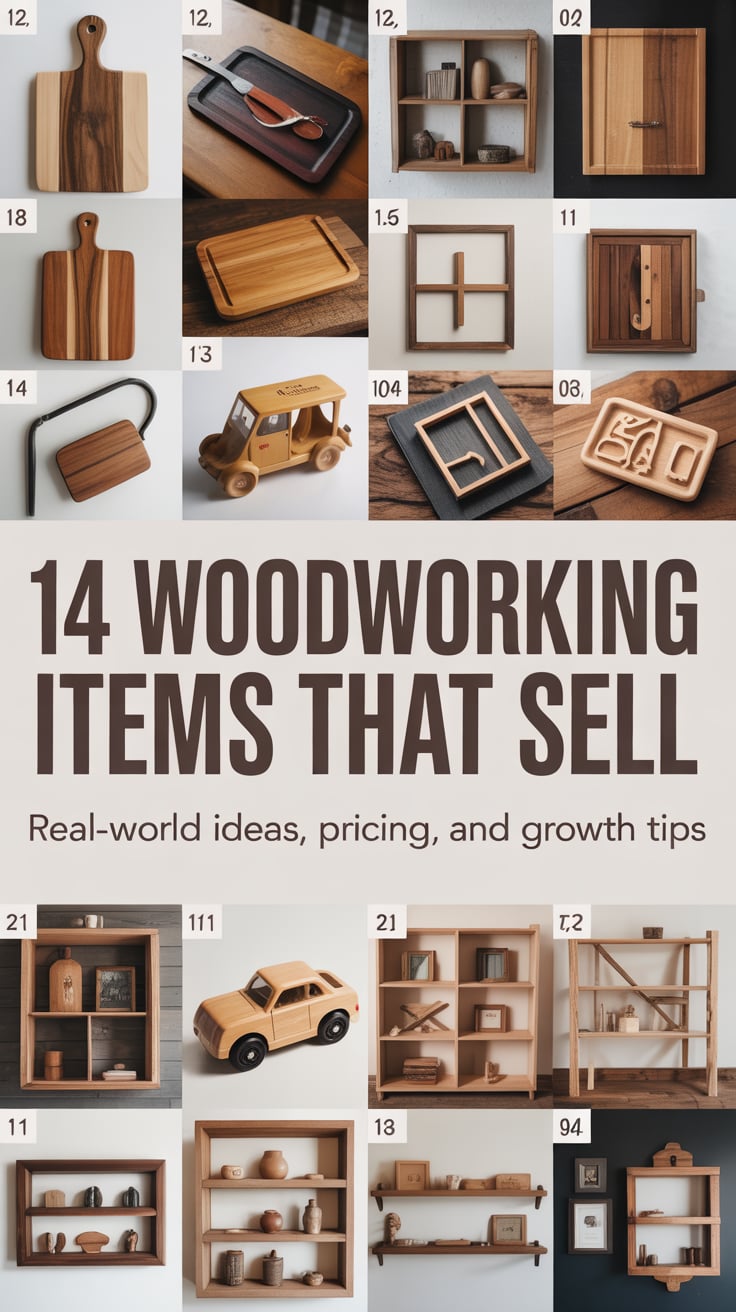
Launching or growing a woodworking side hustle is easier when you focus on proven sellers. This guide breaks down 14 woodworking items that sell consistently, plus practical tips on pricing, finishing, and marketing so you can move from “nice builds” to a predictable cash flow. You’ll also find smart ways to streamline your small shop and a simple 30-day action plan to get orders in the door.
If you want a head start on product selection and sales, the blueprint-style tutorials inside WoodProfits can save you months of guesswork and help you choose items that actually move.
Table of Contents
Home décor woodworking items that sell consistently
These pieces look premium, fit a wide range of interiors, and ship well. Home décor also makes a great “gateway” for repeat customers who will later buy bigger items.
Floating shelves
Why they sell: Minimalist design meets everyday utility. Floating shelves work in kitchens, baths, living rooms, and offices.
Build and finish tips: Use hardwood or high-quality plywood with a solid edge band. Hidden brackets or French cleats make installation clean and sturdy. Satin or matte finishes suit most décor.
Customization: Offer standard lengths and stains; add a premium tier for custom lengths or live-edge options.
Shipping and margins: Ship with mounting hardware and a template. Flat, rectangular geometry reduces shipping damage and costs.Farmhouse signs
Why they sell: Words, coordinates, or family names give buyers an emotional reason to purchase.
Build and finish tips: Reclaimed-look frames with stenciled or laser-burned lettering. Chalky paint or distressed finishes photograph beautifully.
Customization: Monograms, ZIP codes, wedding dates, or local map outlines drive conversions.
Marketing: Bundle with seasonal mini-signs to encourage repeat orders.Picture frames
Why they sell: Frames are a staple in home updates, gifting, and gallery walls.
Build and finish tips: Miters with splines or dowels, glass/acrylic fronts, and acid-free backing. Keep a tight fit to avoid rattle.
Customization: Offer common photo sizes and a discount for 3- or 6-piece gallery sets.
Sales tip: Photograph frames with art or photos buyers can imagine on their wall.Blanket ladder
Why they sell: It’s airy, on-trend, and doesn’t require drawers or doors, keeping build time short.
Build and finish tips: Sturdy rungs with screw-and-plug or dowel joinery. Offer two heights and 2–3 stain/paint finishes.
Display: Lifestyle photos in a cozy room drive clicks and saves on Pinterest and Etsy.
Helpful resource: Learn SEO basics and listing best practices in the Etsy Seller Handbook. Also see [DIY farmhouse decor ideas](INTERNAL LINK PLACEHOLDER) for styling inspiration that boosts product photos.
Kitchen and dining products buyers love
Kitchen pieces benefit from gifting, wedding registries, holidays, and everyday use. They’re tactile, so finishes and edges matter.
Cutting boards
Why they sell: Functional, premium, and ideal for personalization.
Build and finish tips: End-grain is the premium option; edge-grain is faster and cost-effective. Chamfered or round-over edges feel better in hand. Use food-safe finishes and include a care card.
Customization: Engraved initials or coordinates; optional juice groove.
Efficiency: Glue up boards in batches to maximize shop time.Serving trays
Why they sell: “Charcuterie” and entertaining remain hot trends, and trays photograph beautifully.
Build and finish tips: Integrated handles or low-profile hardware, stable hardwood, and a durable finish.
Bundling: Offer “board + knife set” or “board + coaster set” to increase average order value.
Photography: Style with fruit, crackers, and cheese to show scale and lifestyle use.Coaster sets
Why they sell: Budget-friendly checkout add-on and perfect for gift sets.
Build and finish tips: Use contrasting species or inlays. Include a holder or felt feet.
Personalization: Initials, wedding date, or a city skyline etch.
Food-safe note: Always confirm your finishes are suitable for food-contact surfaces where appropriate. See [How to choose a food-safe finish](INTERNAL LINK PLACEHOLDER) for best practices.
Storage and organization solutions that move fast
Organization solves a clear problem and sells briskly year-round. Good product photography showing “mess vs. tidy” can double conversions.
Wall-mounted coat racks with hooks
Why they sell: Every entry needs them, and they’re easy to size for apartments or family homes.
Build and finish tips: Solid wood backboard with quality hooks. Pre-drill mounting holes and include screws/anchors.
Customization: Offer 3, 5, and 7-hook variants, plus a “with shelf” upgrade for keys and mail.
Local angle: Market to realtors or property managers as a move-in gift or staging piece.Desk organizer or monitor riser
Why they sell: Remote work made desk ergonomics and clutter control mainstream.
Build and finish tips: Hyper-precise fit for phones, pens, and notebooks; felt or cork inserts elevate perceived value.
Options: Cable pass-throughs, wireless charger slot, or drawer variations.
SEO tactic: Use multiple keywords in your listing—“monitor stand,” “monitor riser,” “desk shelf”—to capture broader search intent.
Pricing note: Factor material cost, labor time, and overhead before setting your price. The U.S. Small Business Administration’s guidance on pricing your products helps align costs and margins, especially when calculating labor and overhead.
If you’re working from a small garage or spare room, setting up a compact, efficient shop will speed production and improve quality. The tutorials in UltimateSmallShop – The Next Woodworking Blockbuster! focus on layout, dust control, and tool choices that deliver pro results without a huge footprint.
Outdoor woodworking items that sell locally and online
Outdoor pieces invite local pickup (avoiding shipping damage and costs), and they photograph beautifully in natural light.
Planter boxes and raised planters
Why they sell: Gardening and patio upgrades spike in spring, but planters sell year-round as gifts.
Build and finish tips: Cedar or other rot-resistant species; exterior screws and waterproof glue. Offer liners or drainage holes.
Customization: Stain options, lattice trellises, or engraved address numbers.
Local strategy: Partner with plant shops for display and cross-promotion.Birdhouses or bird feeders
Why they sell: Affordable, giftable, and repeatable with seasonal designs.
Build and finish tips: Species-appropriate entrance sizes, easy-clean roof or panel, and safe, exterior-grade finishes.
Bundling: Sell a 3-pack “backyard set” or pair with a small bag of seed.
Photography: Show in a tree or on a shepherd’s hook to help buyers imagine placement.
Trend research: Use Google Trends to time seasonal items (e.g., “planter box,” “bird feeder”). Launch listings before peak interest to build listing history and reviews.
Pet and kid favorites that create loyal customers
Households often spend more readily on their pets and children, and positive experiences spark repeat orders.
Elevated dog feeders
Why they sell: Health and comfort benefits, plus they look better than plastic bowls.
Build and finish tips: Sturdy legs, non-skid feet, removable stainless bowls, and water-resistant finishes.
Sizing: Offer 3–4 heights based on dog size; include a sizing chart in your listing.
Personalization: Dog name engraving, breed silhouette, or color options.Toy blocks and cars
Why they sell: Durable, heirloom-quality toys appeal to parents, grandparents, and gift buyers.
Build and finish tips: Smooth edges, no small choking hazards, and non-toxic finishes only.
Sets: Alphabet blocks, rainbow-stacked blocks, or car/garage sets encourage collection and repeat orders.
Safety resource: Review guidelines from the U.S. Consumer Product Safety Commission before listing children’s items.
Marketing tips:
- Use lifestyle photos with pets or kids (with permission) to showcase scale and use.
- Offer gift-ready packaging during holidays and birthdays to increase conversion rates.
- Use “gift message” and “rush shipping” add-ons.
Small entryway furniture that ships well
Entryway furniture sells because almost every home has a “drop zone” problem. The key is keeping builds sturdy, compact, and shippable.
- Entryway shoe rack or bench
Why it sells: Solves clutter and provides a seating surface for putting on shoes.
Build and finish tips: Choose joinery that survives shipment—dominoes, dowels, or pocket screws with plugs. Offer a slatted shelf to reduce weight and improve airflow. Provide leveling feet for uneven floors.
Modularity: Consider knockdown hardware so long versions ship flat. Include a QR-coded assembly guide to reduce customer support requests.
Options: Hooks on a matching wall panel, cushion add-ons, or a two-tier “kids’ shoe zone” upsell.
Photography: Stage with shoes, baskets, and a coat to make the benefit obvious.
Local sales: Offer “local pickup” and a small discount to offset delivery time. Craft fairs, farmers markets, and community Facebook groups are goldmines for this category. Pair in-person sales with a digital follow-up to collect emails for new product drops. For marketplace optimization, see [Selling crafts on Etsy guide](INTERNAL LINK PLACEHOLDER).
Efficiency tip: Batch-cut common lengths, pre-finish parts before final assembly, and standardize screw types. A compact, well-organized shop boosts production speed. For detailed shop setup and budget tool picks, check out UltimateSmallShop – The Next Woodworking Blockbuster!.
Pricing, costs, and margins for woodworking items that sell
Winning products start with smart pricing. Underpricing hurts growth; overpricing slows sales. Aim for a balanced approach you can defend with quality, finish, and service.
- Calculate cost of goods (COGS): Include lumber, hardware, finish, sandpaper, glue, packaging, and shipping materials.
- Add labor: Track build times accurately. Even if it’s a side hustle, your time has value.
- Include overhead: Tool wear, shop utilities, software, marketing, and marketplace fees all belong in your pricing formula.
- Choose a pricing model:
- Simple: COGS + labor + overhead + profit target.
- Tiered: Standard, Premium (custom dimensions), and Limited (live-edge, exotic species).
- Wholesale vs. retail: Wholesale typically requires higher efficiency and lower per-unit margin but offers volume and predictability.
- Test and iterate: Adjust prices based on conversion rate, production speed, and feedback.
Reference the SBA’s guide on sales and marketing fundamentals to refine your pricing and promotion mix as you scale.
To avoid the “race to the bottom,” position your listing with:
- Superior lifestyle photos and videos
- Clear care instructions (reduces returns)
- Personalization and quick turnaround options
- Bundles and matching sets that raise average order value
For advanced pricing strategies and cost tracking, see [How to price woodworking projects](INTERNAL LINK PLACEHOLDER).
Marketing, listings, and SEO that drive predictable orders
Show up where buyers search and make it easy to say “yes.”
- Photography: Use natural light, multiple angles, context (e.g., shelves on a wall), and scale cues. Before/after scenes work great for organizers.
- Titles and tags: Mix core keywords + style + material + use case (e.g., “Walnut floating shelves, minimalist wall shelf set, modern home décor”).
- Descriptions: Lead with benefits, add dimensions and materials, then care and shipping details.
- Personalization: Prominently feature options and turnaround time.
- Channels: Etsy, your own Shopify/WooCommerce site, Facebook Marketplace, local fairs, and partnerships with local boutiques or plant shops.
- Email list: Include a thank-you card with a QR code linking to a signup page for care tips and new product previews.
- Seasonal planning: Use Google Trends to time launches and inventory (e.g., planters in late winter, gifts in Q4).
Study the Etsy Seller Handbook for category-specific SEO and listing advice, then tailor for your products. If you’re unsure which tools to buy first, skim [Beginner woodworking tools list](INTERNAL LINK PLACEHOLDER) to build a budget-friendly, capable kit.
Recommended resources for builders who want to grow
When you’re ready to go beyond trial-and-error, these step-by-step resources can shorten the path to steady sales. Each complements a different stage of the journey.
WoodProfits
A practical guide to launching and growing a profitable woodworking business. Helpful if you want product ideas, pricing frameworks, and sales channels mapped out without reinventing the wheel.TedsWoodworking
A large library of woodworking plans. Use it to speed prototyping and standardize SKUs for your shop so you can build faster with fewer mistakes.UltimateSmallShop – The Next Woodworking Blockbuster!
Ideal for turning a corner of your garage into an efficient, safe, and clean workspace—key for quicker production and better finishes.My Shed Plans
If you’re outgrowing the garage, shed plans can help you create a dedicated workspace or inventory storage without a full-scale addition.
Simple 30-day action plan to get your first orders
Week 1: Pick your winners and prep the shop
- Choose 2–3 items from the 14 woodworking items that sell above (e.g., floating shelves, cutting boards, coat racks).
- Build one “master prototype” of each with your preferred finish.
- Create jigs for repeatable cuts and a batch-sanding workflow.
Week 2: Photograph, price, and list
- Photograph each item in natural light with lifestyle scenes.
- Write benefit-led titles and descriptions with 10–13 relevant tags.
- Set prices using COGS + labor + overhead, with a second “premium” option.
Week 3: Launch and promote
- List on Etsy and one local channel (Facebook Marketplace or a local group).
- Offer a small launch discount or a bundle.
- Ask 2–3 friends to order at full price with honest reviews and lifestyle photos.
Week 4: Iterate and scale
- Review conversion rates and questions from buyers.
- Improve listings, add a personalization option, and start a simple email list.
- Move to a batch-production schedule for your top seller.
If you want a ready-made roadmap and product ideas chosen for profitability, start with WoodProfits. And if your space is tight, get your workstation dialed in with UltimateSmallShop – The Next Woodworking Blockbuster!.
Conclusion
Focusing on 14 woodworking items that sell—like floating shelves, cutting boards, coat racks, planters, and pet feeders—lets you build a tight, profitable catalog. Start with 2–3 SKUs, standardize your process, photograph with lifestyle scenes, and refine pricing using clear COGS and labor data. Pair that with simple SEO, seasonal planning, and repeat-buyer strategies, and you’ll turn your woodworking into a sustainable source of income. Keep iterating, listen to your customers, and double down on your best sellers.
FAQ
What are the easiest woodworking items that sell for beginners?
Floating shelves, coaster sets, and simple wall-mounted coat racks are beginner-friendly. They require straightforward cuts, minimal hardware, and ship easily.
How do I price woodworking items that sell without undercutting myself?
Calculate materials, labor, and overhead, then add your profit target. Track build times honestly and test a premium tier for customization.
Which finishes should I use for kitchen items like cutting boards?
Use food-safe finishes appropriate for cutting surfaces and include care cards. For trays and coasters, choose durable, water-resistant options.
Where should I sell these products first?
Start with Etsy and a local channel such as Facebook Marketplace or craft fairs
How can I find seasonal demand for woodworking products?
Use Google Trends to time launches—planters in early spring, gift items in Q4. Launch early to gather reviews before peak season.